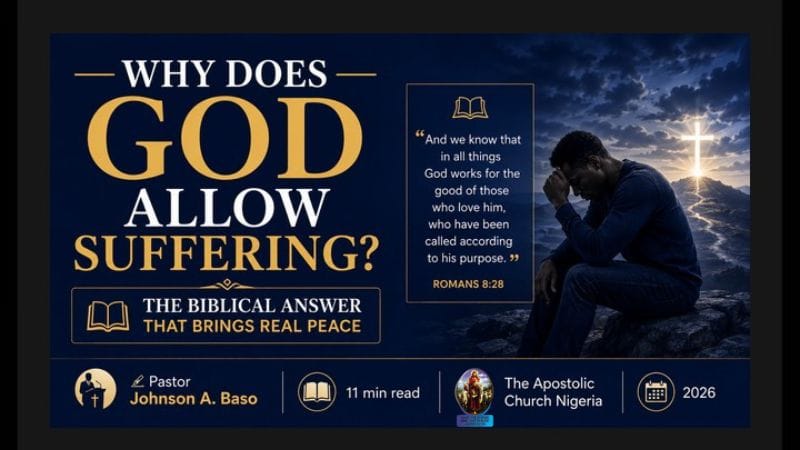
A Biblical Answer to One of Life's Hardest Questions
✍️ By Johnson Baso📖 Biblical study🗓️ September 17, 2026
When Life Hurts, Where Is God?
If God is good, why does He allow suffering? If He is
all-powerful, why doesn't He stop pain? And if He loves us,
why do innocent people suffer?
These are not merely academic questions. They arise when a
loved one dies, when sickness enters a family, when a child
suffers, or when life becomes painfully difficult.
The Bible does not treat these questions lightly. Scripture
gives us truth about God, sin, suffering, human responsibility,
and the hope found in Jesus Christ. It also shows us that
we may trust God even when we do not understand everything
He permits.
In this article, we will examine five biblical truths that help
us understand suffering, consider what the Bible says about
innocent suffering, and discover how God offers comfort and
hope to those who are hurting.
1. Is God Good and All-Powerful?
The question of suffering often begins with two truths:
God is good, and God is powerful. How can both be true
when terrible things happen?
The Bible does not ask us to choose between God's goodness
and His power. It teaches that God is holy, loving, wise,
and almighty.
God Is Good
God's goodness is not merely an idea. It is part of His
character. He is merciful, faithful, righteous, and loving.
We can see this throughout Scripture.
“O give thanks unto the LORD; for he is good: for his
mercy endureth for ever.”
Psalm 136:1, KJV
God does not become good only when life is easy. His character
remains good even when we cannot explain our circumstances.
God Is All-Powerful
Scripture teaches that nothing is too hard for God. He created
the heavens and the earth, sustains creation, and has authority
over all things.
“Ah Lord GOD! behold, thou hast made the heaven and the earth
by thy great power and stretched out arm, and there is nothing
too hard for thee.”
Jeremiah 32:17, KJV
God Is Wise
God's wisdom is greater than ours. We see only part of a
situation, but God sees the whole of His creation and His
redemptive purpose.
“For my thoughts are not your thoughts, neither are your ways
my ways, saith the LORD.”
Isaiah 55:8, KJV
This does not mean that every painful event is good in itself,
or that we should stop asking questions. It means that the
mystery of suffering does not prove that God is evil,
powerless, or absent.
2. Where Does Suffering Come From?
The Bible presents several realities that help us understand
suffering. Not every painful experience has the same cause,
and not every tragedy can be traced to a person's individual
sin.
Human Sin and Wrong Choices
God created human beings with moral responsibility. People
make choices, and those choices can bring suffering to
themselves and others.
Violence, oppression, dishonesty, abuse, hatred, and
exploitation are examples of suffering caused by human
wrongdoing.
“The thief cometh not, but for to steal, and to kill, and
to destroy: I am come that they might have life, and that
they might have it more abundantly.”
John 10:10, KJV
A Fallen Creation
Genesis 3 describes the entrance of sin into human history.
The Bible later describes creation as groaning and waiting
for redemption.
“For we know that the whole creation groaneth and travaileth
in pain together until now.”
Romans 8:22, KJV
This helps explain why suffering is part of the brokenness
of our world. However, we should be careful: the Bible does
not teach that every illness, accident, or natural disaster
is a direct punishment for a particular person's sin.
Spiritual Evil
Scripture also speaks of spiritual opposition and evil.
The Bible calls believers to stand against evil and remain
faithful to God.
“For we wrestle not against flesh and blood, but against
principalities, against powers, against the rulers of the
darkness of this world, against spiritual wickedness in
high places.”
Ephesians 6:12, KJV
The existence of spiritual evil is part of the Bible's
explanation of our world. It is not, however, a reason to
accuse a suffering person of being responsible for their pain.
3. Five Biblical Truths About Suffering
The Bible does not provide a single explanation for every
suffering experience. But it reveals important truths about
what God can accomplish in the lives of His people.
1
God Can Use Suffering to Produce Endurance
Trials can develop perseverance and spiritual maturity.
This does not mean that suffering is pleasant or that
we should seek pain. It means that God can work in us
even through difficult circumstances.
“Knowing this, that the trying of your faith worketh
patience.”
James 1:3, KJV
2
God Can Draw Us Into Deeper Dependence on Him
Suffering can reveal our limitations and lead us to seek
God's help. In our weakness, we may learn to depend more
deeply on His grace.
“My grace is sufficient for thee: for my strength is
made perfect in weakness.”
2 Corinthians 12:9, KJV
3
God Can Teach Us to Comfort Others
People who have experienced suffering may become more
compassionate toward others. God comforts His children
so that they may also comfort those who are hurting.
“Who comforteth us in all our tribulation, that we may
be able to comfort them which are in any trouble.”
2 Corinthians 1:4, KJV
4
Our Suffering Is Not the End of the Story
Christian hope looks beyond this present world. Scripture
promises that God will ultimately redeem His people and
bring an end to death, sorrow, and pain.
“For I reckon that the sufferings of this present time
are not worthy to be compared with the glory which
shall be revealed in us.”
Romans 8:18, KJV
5
God Can Redeem What He Does Not Approve
The Bible shows that God can bring good out of evil
without calling evil good. He can use suffering to
accomplish His purposes, even when the suffering itself
is tragic and painful.
“But as for you, ye thought evil against me; but God
meant it unto good.”
Genesis 50:20, KJV
Important: These truths do not mean that
every tragedy was specifically sent by God to teach someone
a lesson. We should not presume to know the reason behind
another person's suffering.
4. Why Do Innocent People Suffer?
One of the most difficult questions is why people suffer when
they have done nothing to deserve it. The Bible directly
addresses the mistaken idea that every suffering person must
have committed a particular sin.
Jesus Corrected the Disciples' Assumption
In John 9, Jesus and His disciples encountered a man who had
been blind from birth. The disciples asked whether the man
or his parents had sinned.
“Jesus answered, Neither hath this man sinned, nor his
parents: but that the works of God should be made manifest
in him.”
John 9:3, KJV
Jesus rejected the assumption that the man's blindness was
caused by a specific personal sin. His answer reminds us
that suffering cannot always be explained by pointing to
someone's wrongdoing.
Jesus Also Spoke About Tragic Deaths
In Luke 13, Jesus referred to people who died when a tower
fell on them. He asked whether they were worse sinners than
others in Jerusalem and answered, “I tell you, Nay.”
“I tell you, Nay: but, except ye repent, ye shall all
likewise perish.”
Luke 13:3, KJV
Jesus did not say that the victims were more sinful than
everyone else. Instead, He used the tragedy to call His
hearers to repentance and spiritual seriousness.
What About Children Who Suffer?
The suffering of children is especially heartbreaking.
Children can suffer through abuse, neglect, accidents,
illness, war, and natural disasters.
We should never tell a suffering child or family that their
pain proves they are personally guilty before God. Nor should
we claim to know the exact reason God permitted their tragedy.
Scripture calls believers to care for the vulnerable, defend
the oppressed, and show compassion. When someone is hurting,
love should move us toward them, not toward blame.
Remember: We may not understand why a
particular person suffers, but we can still show compassion,
pray, provide practical help, and point people to the hope
of Jesus Christ.
5. Does God Care About My Pain?
If you are suffering right now, you may wonder whether God
sees your tears or hears your prayers. The Bible gives a
clear answer: God is not indifferent to the brokenhearted.
God Is Near the Brokenhearted
“The LORD is nigh unto them that are of a broken heart;
and saveth such as be of a contrite spirit.”
Psalm 34:18, KJV
God does not promise that His people will never experience
pain. But Scripture assures us that He is near to those who
are brokenhearted.
Jesus Understands Human Suffering
Jesus Christ entered our world, experienced sorrow, endured
rejection, and suffered on the cross. He is not a distant
observer of human pain.
“For we have not an high priest which cannot be touched
with the feeling of our infirmities.”
Hebrews 4:15, KJV
Because Jesus understands our weakness, we can come to Him
in prayer with confidence. We do not need to hide our tears
or pretend that everything is easy.
God Invites Us to Bring Our Burdens to Him
“Casting all your care upon him; for he careth for you.”
1 Peter 5:7, KJV
You may bring your questions, fears, grief, and burdens to
God. Prayer is not a denial of suffering. It is an expression
of trust in the One who hears us.
6. Where Can We Find Hope?
Christianity does not promise a life without trouble.
Jesus Himself said that His followers would face tribulation.
But He also gives a promise of victory and hope.
“These things I have spoken unto you, that in me ye might
have peace. In the world ye shall have tribulation: but be
of good cheer; I have overcome the world.”
John 16:33, KJV
Jesus Christ Is the Hope of the Suffering
The central message of the Christian faith is not merely an
explanation of suffering. It is the good news that Jesus
Christ died for our sins, was buried, and rose again.
Through Christ, believers have the promise of forgiveness,
eternal life, and the future restoration of all things.
God Will Ultimately End Suffering
“And God shall wipe away all tears from their eyes; and
there shall be no more death, neither sorrow, nor crying,
neither shall there be any more pain: for the former things
are passed away.”
Revelation 21:4, KJV
This is the Christian hope: suffering will not have the final
word. God promises a future in which death, sorrow, crying,
and pain will be no more.
Until that day, we continue to trust God, seek His help,
care for those who suffer, and hold firmly to the promises
of His Word.
For someone hurting today: You do not have
to understand every reason for your suffering before you
come to God. Bring your pain to Him. Seek support from
trusted believers and appropriate helpers. You are not
required to carry every burden alone.
What Should We Do When We Suffer?
The Bible gives us practical ways to respond to suffering.
These actions do not remove every pain, but they help us
walk through difficult seasons with faith and compassion.
Pray honestly.
Tell God what you are experiencing. The Psalms show that
God's people can bring their grief and questions to Him.
Seek God's Word.
Read Scripture for comfort, wisdom, and the assurance of
God's character.
Receive help from others.
Talk to trusted family members, mature Christians, pastors,
counselors, or qualified professionals when needed.
Care for those who are hurting.
Offer prayer, food, practical support, encouragement, or
a listening ear.
Hold on to Christian hope.
Remember that suffering is not the final destiny of those
who belong to Christ.
Frequently Asked Questions
Why does God allow suffering if He is good?
The Bible teaches that God is good and powerful, yet we
live in a world affected by sin and brokenness. Scripture
does not explain every individual tragedy. It does show
that God can redeem suffering, remain near the brokenhearted,
and ultimately end suffering through Jesus Christ.
Does suffering always happen because of sin?
No. Jesus rejected the assumption that a man's blindness
was caused by his or his parents' personal sin in John 9.
Although sin affects our fallen world, we should not assume
that every illness, accident, or tragedy is a direct
punishment for a specific sin.
Why do innocent children suffer?
Children can suffer because of human wrongdoing, illness,
accidents, and other painful circumstances. The Bible does
not tell us the specific reason for every child's suffering.
Christians are called to show compassion, protect the
vulnerable, and trust God's justice and mercy.
Can God use suffering for good?
Yes. Romans 8:28 teaches that God works all things together
for good for those who love Him. James 1:2-4 also teaches
that trials can produce perseverance and maturity. This
does not mean that suffering itself is good or that every
tragedy was sent to teach a lesson.
Does God care about my pain?
Yes. Psalm 34:18 says that the Lord is near the brokenhearted.
Jesus understands human suffering, and 1 Peter 5:7 invites
us to cast our cares upon Him because He cares for us.
Will suffering last forever?
The Bible promises that God will ultimately end death,
sorrow, crying, and pain. Revelation 21:4 points to the
future restoration of all things. Christian hope rests in
Jesus Christ and His promise of eternal life.
What should I do when I am suffering?
Pray honestly, seek God's Word, receive support from trusted
people, and seek appropriate practical or professional help.
You do not need to pretend that pain is easy or carry every
burden alone.
🙏 A Prayer for Those Who Are Hurting
Heavenly Father, I come before You with my pain, questions,
and burdens. You know what I am going through, even when
I cannot find the words to explain it.
Please give me strength for today, wisdom for the days ahead,
and comfort in my sorrow. Help me to trust Your goodness
even when I do not understand Your ways.
Draw me closer to Jesus Christ. Help me to receive the support
of others and to show compassion to those who are hurting.
Fill my heart with the hope of Your promises.